
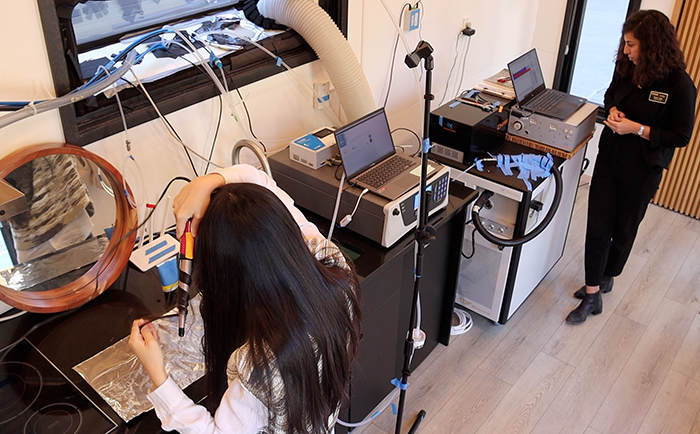
Researchers at Purdue University have discovered the average morning routine for many Americans includes inhaling several milligrams of chemicals that may be harmful to their health—but is there a solution right in our own homes?
Let’s consider the research for a minute before we dig into the potential solutions. The study finds many chemicals—especially those that are in hair care products—can linger in the air after use. The average person can inhale a cumulative mass of 1-17 milligrams of potentially harmful chemicals in a single hair care session in their home.
“We found the results to be extremely alarming,” Nusrat Jung, an assistant professor in the Lyles School of Civil Engineering, Purdue University says. “We did not expect to see such significant emissions of volatile chemical mixtures from off-the-shelf hair care products during typical hair care routines that many people perform each and every day.”
The research additionally noted applying high heat to these chemicals, such as though curling irons and hair straighteners, releases the chemicals into the air even further. When met with temperatures of 210 degrees Celsius, researchers found the chemical emissions from hair care products increased anywhere from 50% to 310%.
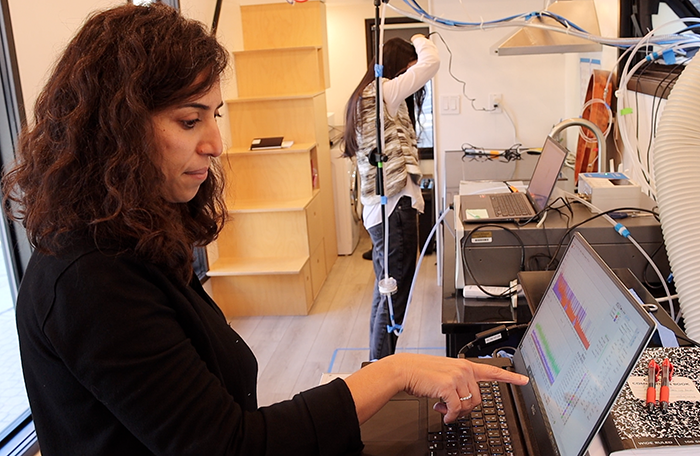
Surveys on different population groups indicate 16% to 70% of participants use leave-on hair care or hair styling products. The research suggests the best solution is to simply not use these products at all. But if one must use these products, the next best thing is to have an exhaust fan running to minimize the amount of chemical inhaled.
“Ventilation can be an effective way to reduce siloxane exposures during indoor hair care routines,” Purdue civil engineering PhD student and researcher Jinglin Jiang says. “Our model shows that turning on the bathroom exhaust fan can reduce D5 inhalation exposures by over 90%.”
This, unfortunately, is a catch 22 though. Using ventilation could further contribute to its environmental impact. Jung’s research reports the cumulative indoor-to-outdoor D5 emission with the exhaust fan always off reaches 710 milligrams within three hours, while the indoor-to-outdoor D5 emission with the exhaust fan always on reaches 900 milligrams within only one hour.
A poor home ventilation system could be a major pathway to indoor-to-outdoor siloxane transport, according to the research. But as we know here home ventilation systems are becoming better and technology itself could theoretically become a solution to such problems with chemicals in our homes in the future.
Perhaps there is an opportunity here to study this problem that we face and develop a solution that will be better for our homes and our environment.
Want to tweet about this article? Use hashtags #IoT #sustainability #AI #5G #cloud #edge #futureofwork #digitaltransformation #green #ecosystem #environmental #circularworld