

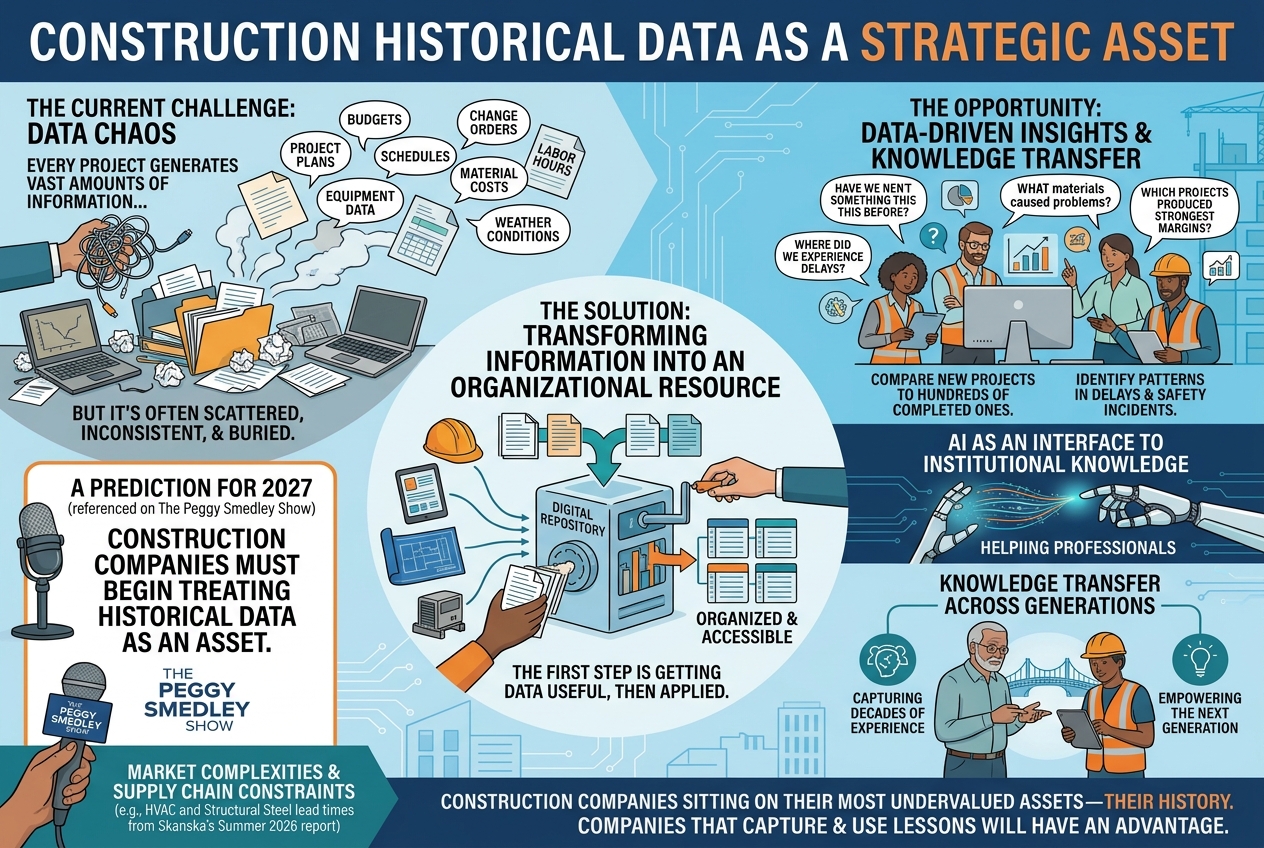
Construction companies have always been data-rich businesses. Every project generates an enormous amount of information—from project plans and budgets to schedules, change orders, inspections, safety reports, equipment data, material costs, labor hours, weather conditions, and countless other details.
But there is a difference between having all that data and actually putting it to work, which is why one of my recent predictions for 2027 that I mentioned on The Peggy Smedley Show is construction companies must begin treating historical data as an asset. Let me explain.
Think about what happens when a project ends. The building is complete, the customer takes possession, and the project team moves on to the next job. The information created during that project usually remains somewhere, but it may be scattered across different software systems, spreadsheets, PDFs, emails, and documents. The data still exists, but finding it—and, more importantly, making sense of it—in many cases is a nightmare.
This is beginning to change. Imagine being able to look at a new project and immediately ask: Have we built something like this before? What did it cost? How long did it take? Where did we experience delays? Which subcontractors performed well? What caused cost overruns? Which materials created problems? Which types of projects produced the strongest margins? What can we build better?
Those are extremely valuable questions, and construction companies already have much of the information needed to answer them. The opportunity is to turn that information from an archive into an organizational resource.
This becomes even more important as the construction market grows more complex. Skanska’s Summer 2026 Construction Market Trends Report highlights how strong demand in areas such as data centers, infrastructure, power generation, advanced manufacturing, pharmaceuticals, and healthcare is running into constraints around labor, power, equipment, and materials. In some markets, structural steel lead times have reached 40 to 50 weeks, while HVAC (heating, ventilation, and cooling) equipment lead times can stretch to 52 weeks.
When a project decision can have consequences months—or even years—in advance, knowing what happened on previous projects becomes incredibly valuable.
Of course, historical construction data is rarely perfect. Different project teams may record information differently. Data can be incomplete or inconsistent. Important knowledge may be buried in documents that were never designed to be analyzed. That means the first step is not necessarily AI (artificial intelligence). The first step is getting the data organized, accessible, and useful.
But once that foundation exists, AI will become an important interface to a company’s institutional knowledge. A project manager will be to ask more insightful questions to a system to identify previous projects like the one being planned. An estimator will compare a new project against hundreds of completed projects. A procurement team just might fully examine historical material pricing and delivery problems. A superintendent will really see patterns in previous schedule delays or safety incidents.
The AI is not replacing the estimator, project manager, or superintendent. It gives those people something they have never had at this scale: an ability to quickly access the collective experience of their organization.
This will be particularly important as the construction workforce changes. As experienced professionals retire, companies risk losing decades of knowledge. That knowledge does not always exist in a database. Sometimes it exists only in someone’s memory—the reason a particular subcontractor was selected, the lesson learned from a difficult project, or the seemingly small decision that prevented a major problem.
What happens when that person leaves? This is where historical data can become more than information. It can become a mechanism for knowledge transfer.
A younger project manager may not have decades of field experience, but technology will help connect that person to the lessons contained in decades of completed projects. Instead of starting from scratch, the next generation worker can start with the accumulated knowledge of the people who came before them. This enables these workers to know the right questions to ask rather than stumble along.
Construction companies are sitting on one of their most undervalued assets—their history. The companies that capture those lessons and make them accessible will have an advantage over those that simply store the information and move on.
Want to tweet about this article? Use hashtags #construction #IoT #sustainability #AI #5G #cloud #edge #futureofwork #infrastructure