

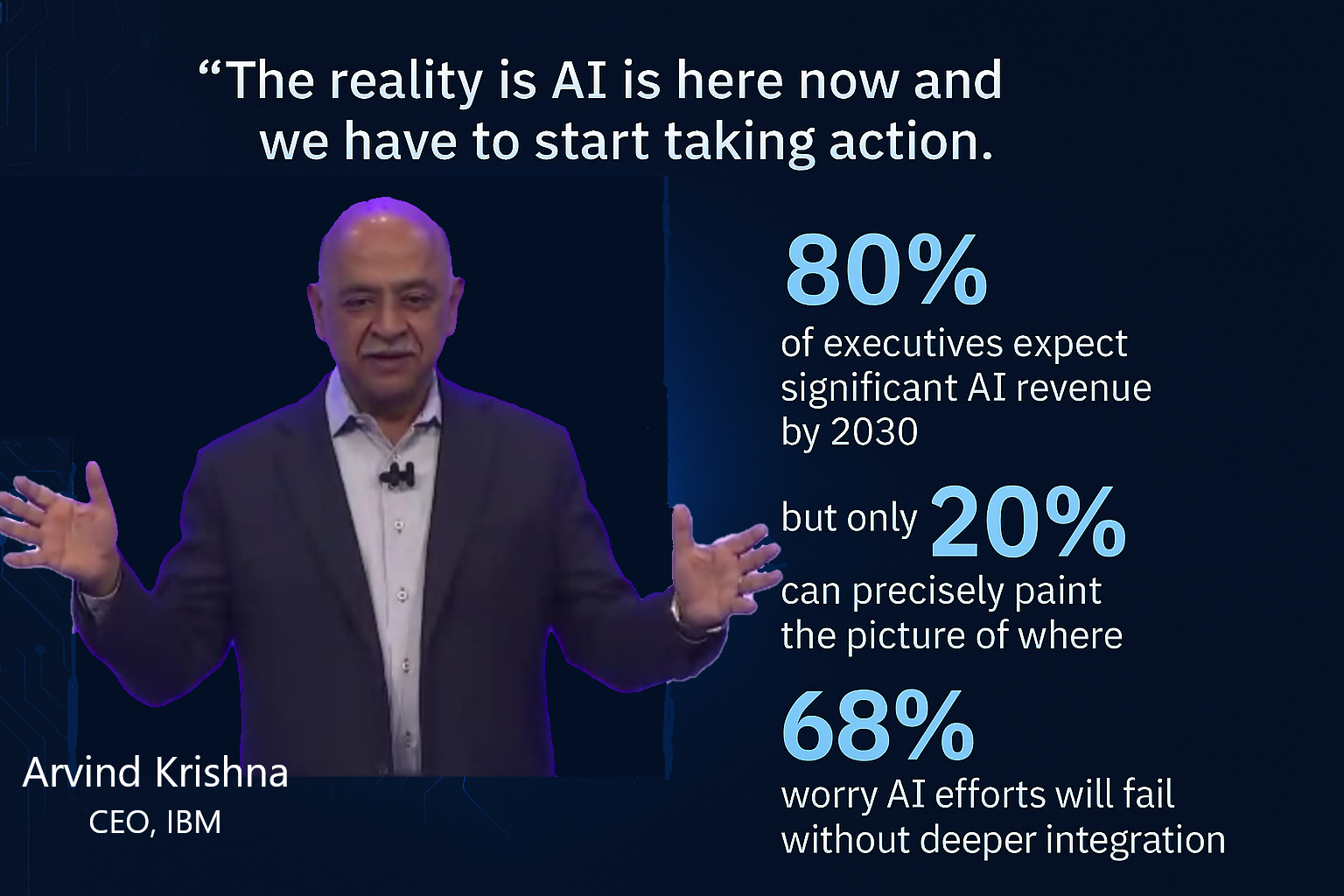
Today, AI (artificial intelligence) is reshaping business fast, but there is still a gap. This is precisely the conversation that is happening at IBM Think this week, May 4-7, in Boston, Mass., as we explore day zero of the AI revolution. The reality is AI is here now and we must start taking action.
“The gap between who is winning and who is falling behind is increasing. What I want you to start thinking about is why is that happening,” Arvind Krishna, chairman and CEO, IBM, says in his keynote.
He shares 80% of executives expect significant AI revenue by 2030, but only 20% can precisely paint the picture of where. Also, 68% worry AI efforts will fail without deeper integration.
“The question comes down to how deeply is AI embedded in your business processes,” he says. “Is it a part of the enterprise? Or is it something on the side? That is the real question. How do you truly become an AI-first enterprise?”
To address this, his opening keynote focused on three vectors:
- AI across the enterprise
- Hybrid cloud architecture
- Quantum frontier
Let’s explore each of these three areas briefly to identify how businesses can become an AI-first enterprise.
AI Fuels Business
Sami Al-Ajmi, senior VP for physical and information technology, Aramco, joined the stage to share a compelling case study of how the energy company and IBM work together. AI is being used in several ways. Firstly, AI is increasing efficiency, increasing reliability, and reducing cost. For example, in-house global optimizers can give a 360-degree view on all assets. Secondly, almost 10 billion data points are generated daily from the assets and that data fuels the business. Aramco has moved AI from lab to the field and from pilots to platforms and solutions, and from potential to billions of dollars in value. The key lesson learned here is to always tie AI to business value.
Moreover, this is not a new story but a story that is driving home industrial growth over years of understanding and I like that Al-Ajmi made a very bold statement when he emphasized the collaboration is more than just words. Al-Ajmi stressed the point that both Aramco and IBM can walk the talk and reshape industrial energy. And to say you are an enterprise reshaping industrial energy is no small statement, particularly in an era defined by volatility, geopolitical tension, and a backdrop of unprecedented global energy systems under extraordinary turbulence.
IBM Bob is also a big part of the AI conversation here at IBM Think. Those who have met Bob know it is an AI-powered software development system designed to transform how enterprises build, modernize, and manage applications. This means organizations have applied Bob across their development environments, not just to write code faster but to rethink how software gets built at enterprise scale. Already, Bob has been adopted by more than 80,000 users and teams are seeing an average of 45% productivity gains. So far, Bob’s got a thumbs up.
Hybrid Cloud Architecture
One of the big challenges that still remains is siloed data, fragmented infrastructure, and multiple clouds. Krishna suggests hybrid architecture can be the solution.
“How do you have an architecture that brings it all together? That is what we mean by a hybrid architecture and a hybrid cloud,” Krishna says. “An architecture that can bring AI to your data. Hybrid is not a compromise. Hybrid is the architecture that helps give you resilience.”
During the first day of IBM Think, the company shared several key announcements around hybrid cloud. IBM Concert is an agentic operations platform that connects signals from existing tools into shared, system-wide context and coordinated action across a hybrid estate. IBM Sovereign Core enables enterprises, governments, and service providers to deploy and operate AI-ready sovereign environments with full customer control over data, operations, and governance across a hybrid environment.
You can’t talk about agentic without talking about realtime data streaming integrated into agentic systems. And this is where Confluent fits into the story nicely. Together, IBM and Confluent provide an open, hybrid data foundation that turns live business events into governed, AI-ready data for applications, analytics, and AI agents across the enterprise.
A Quantum Frontier
Krishna suggests quantum often gets two extreme reactions: the people who dismiss it and the people who believe that it is getting oversold. “Neither of those two extremes is serving you well,” he says.
Quantum is the first new computing paradigm in more than 80 years, and it is a paradigm shift. “It’s an engineering problem today, and when something moves from science to engineering, the question you got to start asking yourself is when is it going to be there and how fast is it going to be there.”
IBM quantum computers leverage speed, scale, and quality to power scientific discovery. There was a powerful example shared on stage at Think from IBM’s client Cleveland Clinic.
Dr. Serpil Erzurum, executive vice president, chief research and academic officer, Cleveland Clinic, said, “The problem for me now is not what’s next, but what is not next.” She stated the Cleveland Clinic wants to have impact in predictions, health, drug discovery, but also operational excellence and logistics and that means improving access and finding the right things for the right patients.
In my next blog, tell me what’s on your mind. If there’s a question you think I should be asking, tell me, I’ll try to get the answer before I leave Boston. I will be addressing the data issue in the next column.
Many organizations are just beginning to consider how we build AI-first enterprises. This is certainly only the beginning of the story. There is more to unfold in the days ahead.
Want to tweet about this article? Use hashtags #IoT #AI #futureofwork #quantum #hybridcloud #IBM #Think2026