

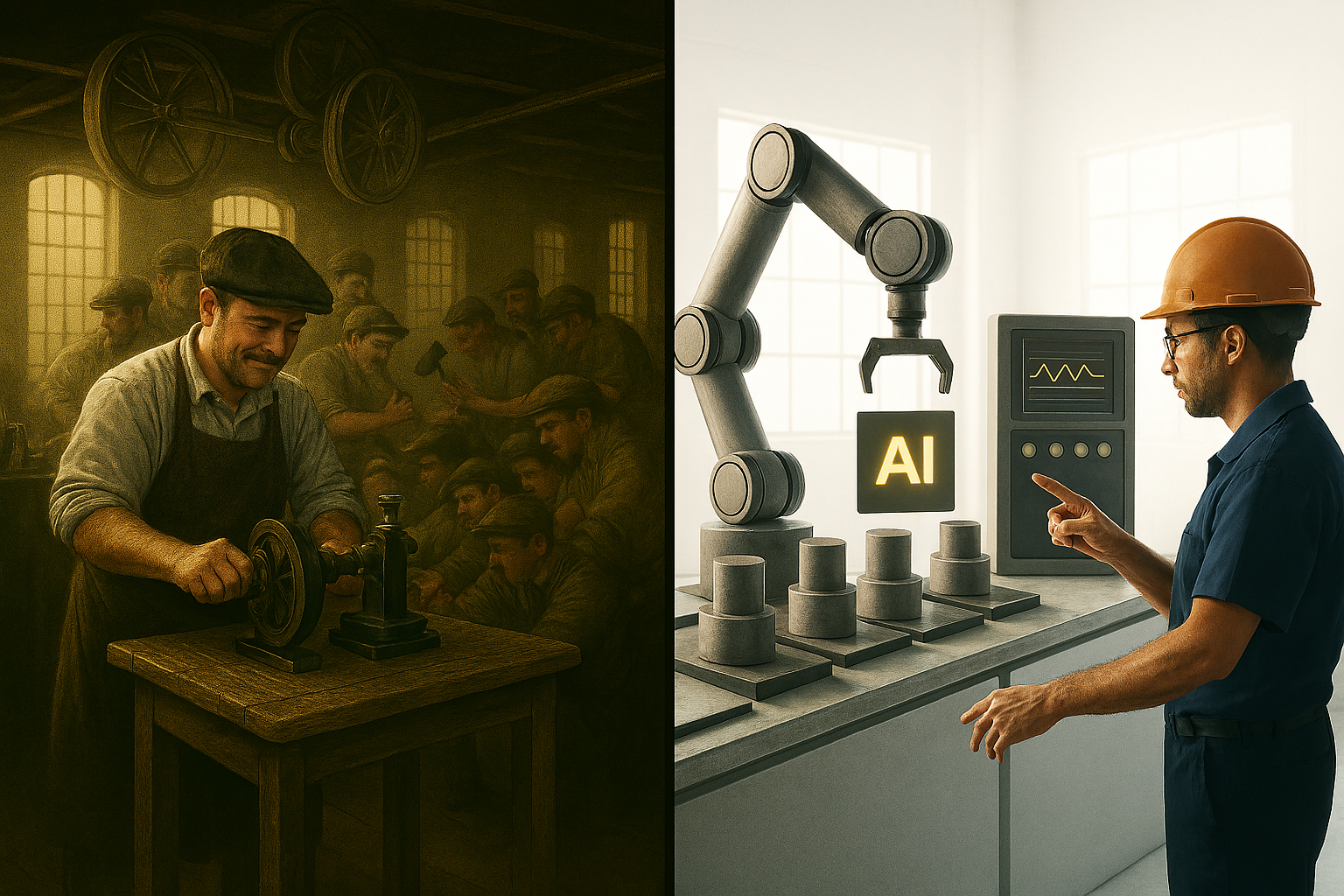
Journey back with me 20 years ago. Manufacturing leaders were asking whether automation would fundamentally change the workforce. Today, the conversation has shifted, albeit only slightly. Now, the debate centers on AI (artificial intelligence), robotics, and what many are beginning to call physical AI. And once again, the fear narrative dominates the headlines: Will machines replace people?
But perhaps we are asking the wrong question. The manufacturing industry has always evolved through disruption. Steam power changed labor. Electrification changed productivity. The internet changed connectivity. Industrial IoT (Internet of Things) changed data access. And now AI is changing decision-making itself. Yet every industrial revolution did more than eliminate tasks. Rather, it created entirely new industries, new services, and new opportunities that previously did not exist.
That is the part of the conversation too many are missing today. When Mending Manufacturing was first published in 2004, the focus was on restoring the strength of American industry amid outsourcing and globalization. There was concern the United States was losing its manufacturing identity altogether. Back then, connected factories were still emerging concepts. Predictive maintenance was new. Digital twins were not part of everyday industrial language. And AI, at least in the practical industrial sense, was nowhere near the boardroom conversations it dominates today.
Looking back two decades later offers something incredibly valuable: perspective. Some predictions from that era proved remarkably accurate. Manufacturers did embrace connectivity. Supply chains became global ecosystems. Data emerged as one of the most valuable industrial assets. Smart manufacturing became real. But other assumptions missed the mark entirely. Few anticipated the pace of cybersecurity threats. Few predicted the fragility exposed by pandemic-era supply-chain disruptions. (well not entirely). And perhaps most importantly, many underestimated the resilience—and importance—of human expertise.
Human Centric Manufacturing
That lesson matters today as AI enters the factory floor. The current discussion around physical AI often sounds eerily familiar to earlier fears surrounding robotics and automation. The assumption is intelligent machines are simply replacing human labor. But history suggests something more nuanced happens during periods of industrial transformation. Technology shifts labor. It changes workflows. It creates new specialties. It demands new skills. And in many cases, it creates industries we could not previously imagine. Look, we all can stand to learn new tricks. With AI and Agentic AI, I must admit I have learned so much. Everyday I am smarter than the day before and it forces me to get out of my comfort zone.
The rise of industrial AI may very well follow the same path. Already, manufacturers are experimenting with AI-enabled robotics, autonomous inspection systems, machine vision, digital engineering, and realtime operational intelligence. Factories are becoming environments where software can increasingly interact with the physical world. But these technologies still require human oversight, strategic thinking, ethics, systems integration, and domain expertise.
In other words, the future of manufacturing is unlikely to be human versus machine. It will be human plus machine. Think of the possibilities. Partners in every way possible. That distinction becomes even more important when we look ahead to 2040. Reports across the industrial sector point toward several converging trends: aging workforces, reshoring initiatives, sustainability pressures, energy transformation, resilient supply chains, and AI-driven operations. The factories of the future may be highly automated, but they will also require a workforce capable of managing complexity at an entirely new level.
The Leader of Tomorrow
The manufacturers that succeed will not simply deploy AI tools. They will rethink how humans and intelligent systems collaborate together. And that raises another important issue: leadership.
Today, much of the AI conversation is being driven by technology companies, consultants, and platforms with products to sell. Manufacturing leaders need something more practical and grounded. They need context. They need historical perspective. They need honest assessments about what worked, what failed, and what still remains unresolved after decades of digital transformation.
This next chapter is not just about AI. It is about industrial reinvention. It is about whether the United States can lead in advanced manufacturing while balancing automation with workforce development. It is about building resilient supply chains while creating high-value industrial jobs. It is about ensuring technology strengthens industry rather than hollowing it out.
Most importantly, it is about understanding every major industrial shift creates uncertainty—but it also creates opportunity. Manufacturing stood at a crossroads 20 years ago. Today, it stands at another. The difference is that this time, the pace of change may be even faster, the stakes even higher, and the opportunity even greater for those willing to rethink what manufacturing can become in the age of AI.
Want to tweet about this article? Use hashtags #IoT #sustainability #AI #5G #cloud #edge #futureofwork #digitaltransformation