

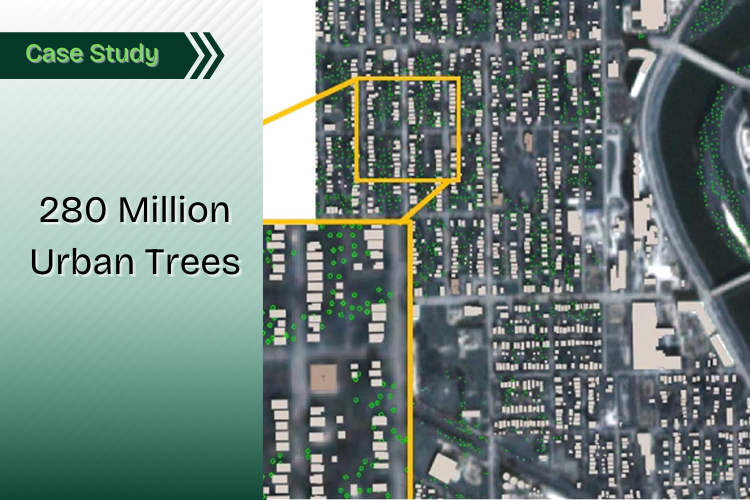
The NYC Million Trees Initiative took 2,000 volunteers and more than 30,000 hours to count the street trees in New York City. New AI (artificial intelligence) technology can help do that in under an hour.
At Purdue University, a digital forestry team has created a computational tool to obtain and analyze urban tree inventories on public and private lands. The AI-enhanced visual computing method combines AI with satellite data to monitor urban trees.
To help their system better understand urban tree distribution, the researchers trained their foundational model at Purdue’s Rosen Center for Advanced Computing. The three-week training process involved 100 GPUs (graphics processing units), mainly using the Gilbreth supercomputer. It has already determined the locations of trees in more than 330 U.S. cities with a population of 100,000 or more. The method has individually identified 280 million urban trees.
Here is how this can help:
- Identify loss in vegetation following a wildfire.
- Save millions of dollars to conduct tree inventories in large cities.
- Provide more precise data such as distance between trees and buildings as well as backyard tree counts.
Looking to the future, this method will help cities with more limited resources to conduct tree inventories easily, quickly, and thoroughly. It is a great example of how AI and digital forestry can help solve some of the issues facing urban environments today by connecting advanced computing infrastructure with disciplines such as forestry, agriculture, and urban sustainability.