

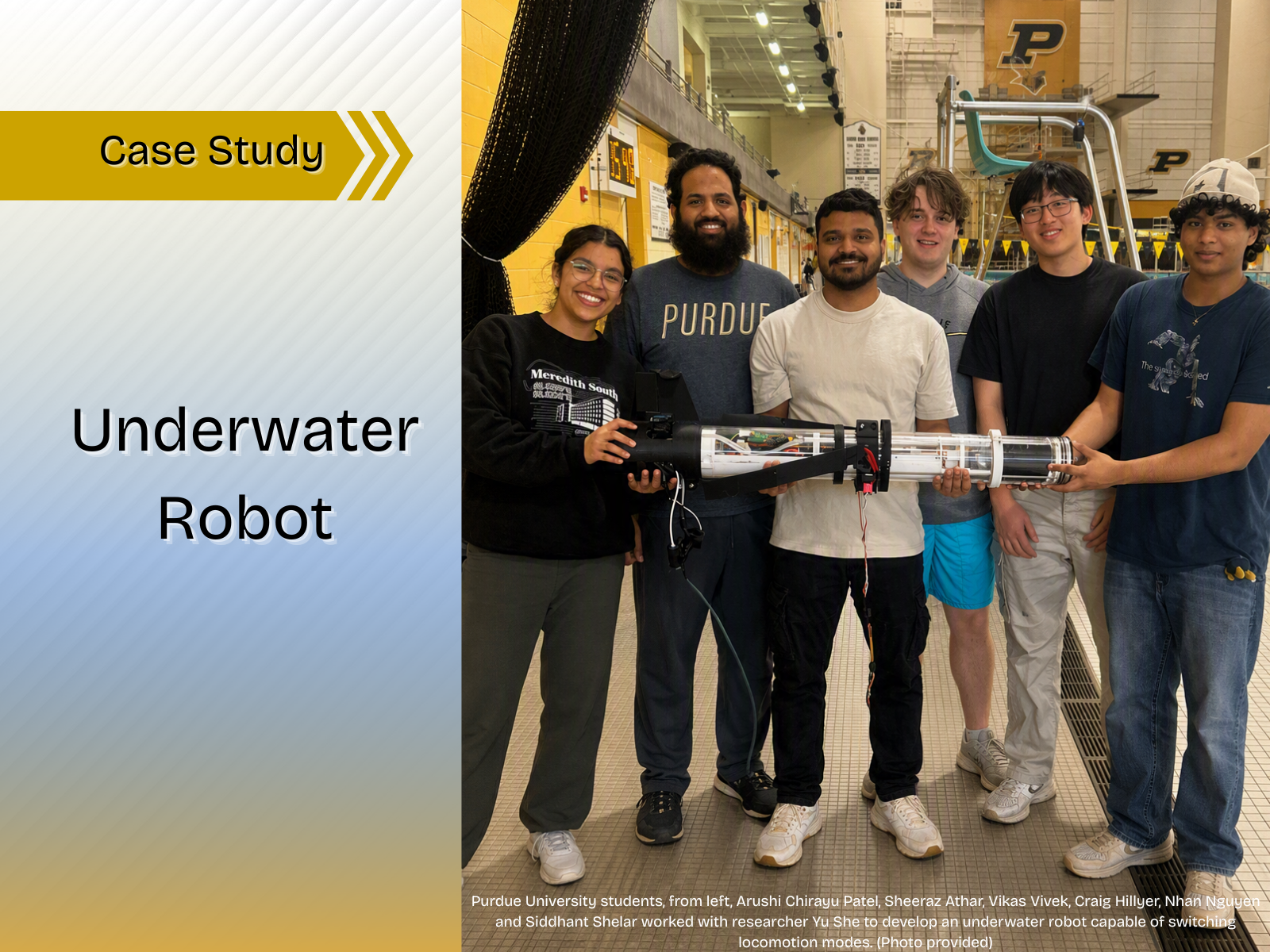
Technology continues to open new possibilities for ocean research, underwater infrastructure inspection, and search-and-rescue efforts. As underwater missions become more complex, researchers are developing robots that can adapt to changing conditions and mission needs.
As one example, researchers at Purdue University have developed a patent-pending underwater robot that can change how it moves during a mission. The robot combines three modes of locomotion—drifting, gliding, and thruster-driven propulsion—allowing it to adapt its mobility strategy based on the mission requirements or environmental conditions.
Here is how this can help:
- Conserve energy and travel farther by driving or gliding when conditions allow.
- Adapt to changing mission needs by switching between the three modes of locomotion.
- Reduce the need for multiple specialized vehicles.
- Improve mission reliability in constrained or uncertain environments.
Looking to the future, underwater robots could play an even greater role in ocean and lake monitoring, current and flow mapping, underwater infrastructure inspection, exploration beneath ice shelves, environmental sensing, and distributed underwater data collection. Purdue researchers plan to further develop the technology by evaluating energy efficiency, endurance, maneuverability, mode-transition performance, and robustness under more realistic underwater conditions.