

Sustainability in manufacturing and the supply chain is important for many reasons. Today, this linear economy of take-make-waste, where we see material flow directly from resource extraction through manufacturing processes to landfills, has reached its capacity. And quite frankly, sustainability is often good for business and for the bottomline.
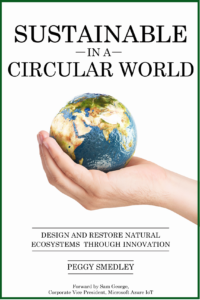
In my book, Sustainable in a Circular World, I wrote about the change I saw coming, saying, corporate sustainability is on the rise within companies and it is driving significant cultural change within organizations and individuals. We are witnessing it in terms of how actions and behaviors are creating corporate transformation and its social and environmental impact. This metamorphosis is pushing companies and people to make significant transformation from now until 2030.
Defining Sustainability in Manufacturing
In my book, I point to Merriam-Webster’s definition of sustainability as relating to or being a method of harvesting or using a resource so that the resource is not depleted or permanently damaged. Simply put, it is environmentally sound living without compromising the needs of future generations.
In manufacturing, we see many examples of this. In fact, it’s no wonder generative family businesses like Mars Corp., makers of M&M, Petcare, and more, have a deep understanding that the long-term future of its business depends on its commitment to the planet. It is constantly trying to reimagine the way business is conducted.
This is a company that asks the tough question: how can an almost 110-year-old company sustain itself for another century? What is the long-term view and a focus stewardship across generations that encompasses profit, people, technology, and the planet. This is an example I explore in greater depth in my book.
We simply can’t have a conversation about sustainability in manufacturing without having a conversation about the scopes. Scope 1 emissions covers the greenhouse gas emissions that a company makes directly. Scope 2 emissions are emissions that a company makes indirectly like when it purchases electricity for heating and cooling of buildings or for data centers. Scope 3 emissions, this is where it gets tricky. This is the category that is associated with everything else and not just the company, but all of the suppliers upstream and downstream of the value chain.
And, quite frankly, we can’t manage these emissions without good, quality data. Data and insights will be key to enabling all of this. AI (artificial intelligence) can play a powerful role in helping organizations measure, manage, and reduce Scope 3 emissions. Quite frankly, AI can help in many areas of sustainability in a business, especially if we are all looking at good data.
AI and Sustainability in Manufacturing
Let’s consider a few examples. Machine learning and natural language processing can help gather data from supply chains and process the data, providing key insights to workers. It’s not having machines make decisions in a vacuum, it’s about machines taking all the information and alerting teams of something that might be happening and how to change course for improved productivity, or to turn an unhappy customer into a life-long one. Those insights can help predict and identify how to optimize the supply chain.
At the same time, digital twins can create a virtual replica, helping identify the carbon impact of materials and transport and production methods. All of this and more can help identify how to lower emissions.
All in all, AI can help redesign products for circularity, sustainability, and a better world for all. But this only works if we have clean data. It only works if the clean data provides contextualized insights. The opportunities are huge, but we must proceed with wisdom.
Again, as a cautionary, without understanding how you plan to implement the data for your company with your people guiding the ship, efforts to achieve success could be costly. Simply, you do not want to find yourself back to the drawing board and retracing your steps all over again. Honestly, having talked to a few manufacturers who have had to do just that, it just might suck!
Want to tweet about this article? Use hashtags #IoT #sustainability #AI #5G #cloud #edge #futureofwork #digitaltransformation #green #ecosystem #environmental #circularworld