

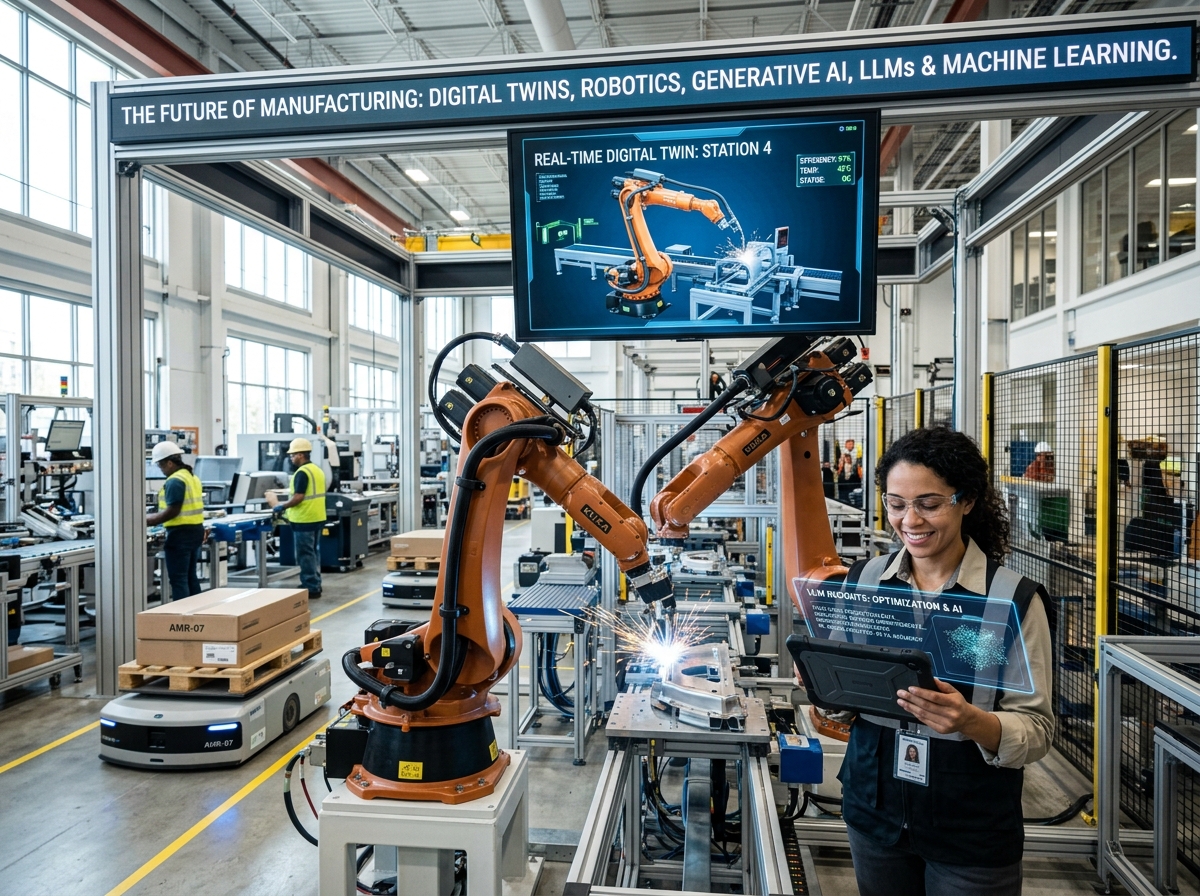
Here at Connected World and The Peggy Smedley Show, we have spent the last few years talking about AI (artificial intelligence), and now there is an AI revolution happening—one that is much more physical, and it is happening on the factory floor.
The 2026 Roadmap on Artificial Intelligence and Machine Learning for Smart Manufacturing, published by NIST (National Institute of Standards and Technology), makes one thing clear: AI and machine learning are moving deeper into the systems that make, move, measure, and maintain the things we depend on every day.
Why? Because manufacturing is not an isolated industry that exists somewhere far away from our daily lives. It is connected to the products we buy, the cars we drive, the buildings we live and work in, and the supply chains that keep our economy humming.
All those systems are now becoming more intelligent, which means we could see factories become far more predictive. Instead of waiting for a machine to break, AI can analyze enormous amounts of industrial data and identify patterns that humans might never see. Instead of discovering a quality problem after a product comes off the line, advanced sensing and machine learning could help identify it earlier.
Of course, this is easier said than done. The hard part is putting intelligence into the messy, complicated physical world. As we know, factories have legacy systems. They have different machines, sensors, software platforms, and control systems that were never necessarily designed to work together. The NIST roadmap identifies this integration challenge, along with data management, and the need for AI that is trustworthy, explainable, and reliable in high-stakes environments.
And here is where the conversation gets interesting. We don’t just need AI that is smart. We need AI that we can trust.
Imagine a factory worker receiving an alert that a machine is about to fail. The system says it has determined there is a 93% probability of failure. What happens next? The worker needs to understand why. The worker needs to know what data informed the decision. The company needs to know whether the system is reliable enough to act upon. That is a very different AI conversation than asking a chatbot to write an email.
It is also why technologies such as digital twins, robotics, generative AI, large language models, and machine learning are becoming so important to manufacturing’s future. The roadmap points toward a world where these technologies increasingly work together across highly connected industrial systems.
But I think we should look beyond the technology itself. The real question is: What does this mean for people? If AI takes over repetitive monitoring, perhaps workers can spend more time solving problems. If machines become more predictive, perhaps downtime becomes less disruptive. If AI helps optimize supply chains perhaps manufacturers become more resilient when the unexpected happens. That is the opportunity.
Still, opportunity does not automatically equal progress. We must build the skills, standards, infrastructure, and trust alongside the technology. Otherwise, we risk creating incredibly intelligent systems that are too difficult, or certainly, too unreliable, to use.
The factory floor is where intelligence meets reality. And when AI can reliably understand machines, materials, workers, processes, and supply chains, we may finally begin to see what an intelligent industrial ecosystem can really become.
Want to tweet about this article? Use hashtags #IoT #sustainability #AI #5G #cloud #edge #futureofwork #digitaltransformation