

The construction industry has a workforce challenge that impacts more than just hiring. The industry needs to develop people, build skills, and create career paths that encourage workers to commit to the industry and continue to grow with it. These statements seem to be coming up a lot lately. In fact, this is precisely what we see emerge with the data from a new report.
As we see in a Jobs for the Future report, the state of America’s skills trades is important to a broader workforce conversation. Here’s what the numbers show us: More than 18 million people work in skilled trades occupations, contributing an estimated $3.8 trillion to U.S. GDP in 2025.
The report suggests five key findings:
- Demand is substantial and preparation is not keeping pace with growth and replacement needs.
- There is no single skilled trades shortage. Needs differ by occupation and place.
- Skilled trades workers enter through multiple pathways, but hands-on learning is essential.
- Too many potential workers are lost between preparation and career.
- Perception of the trades is positive, but information and navigation gaps remain.
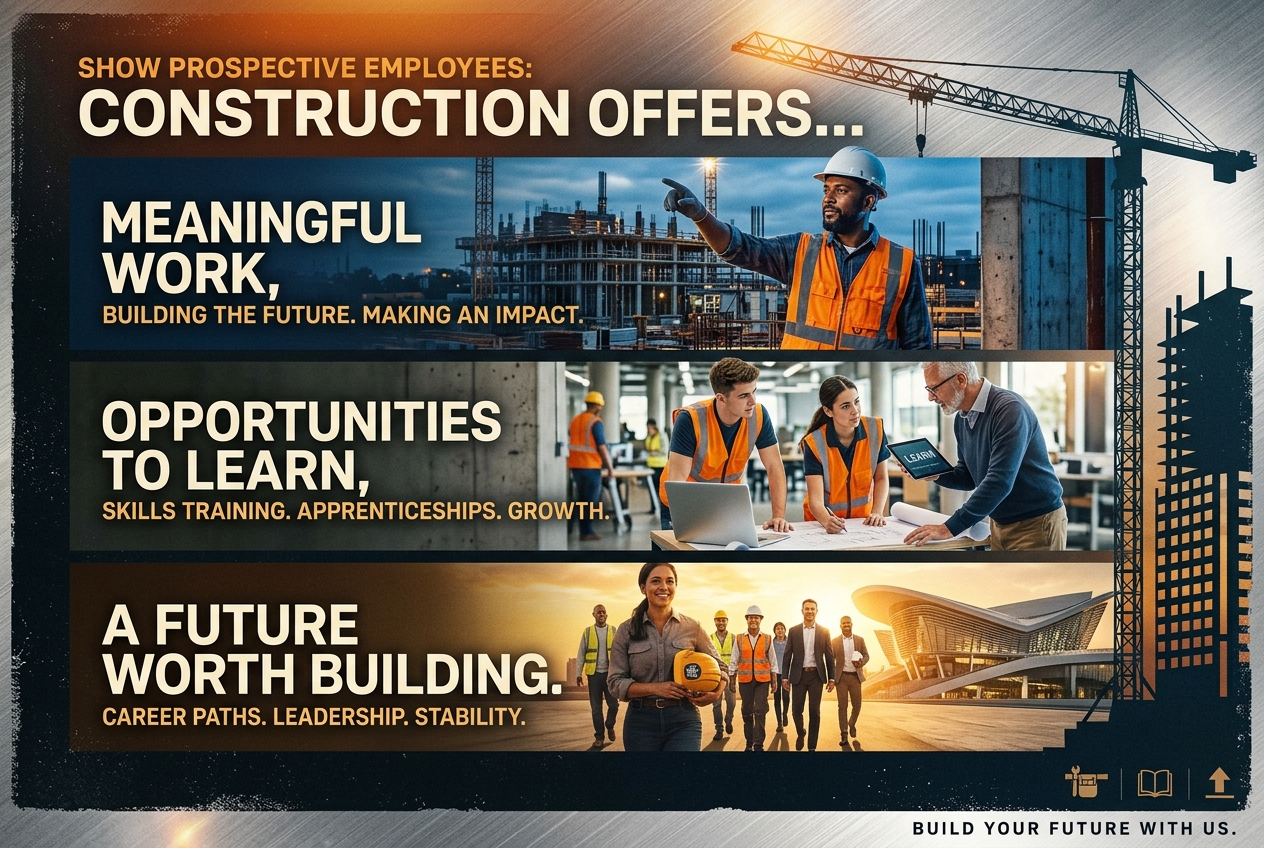
What can we take away from this? Recruitment is really only the beginning. Construction companies need to show prospective employees that construction offers meaningful work, opportunities to learn, and a future worth building.
Let’s consider one example. In the New York metropolitan region, Skanska is taking steps to strengthen the talent pipeline through hands-on training, mentorship, and skills programs designed to help employees advance their careers. The company’s Core Competency Training Program gives early career professionals exposure to different project roles and responsibilities. Participants gain experience in areas such as field engineering, estimating, project controls, and safety, just to name a few.
Understanding how decisions in one area affect another can help professionals become better problem solvers, collaborators, and future leaders.
Still, it is important to remember new hires are simply one rung of the workforce development chain. Experienced field employees also need opportunities to build leadership skills and prepare for greater responsibility. Thus, Skanska’s Superintendent Development Program offers a pathway for craft foremen and field engineers to develop the technical and interpersonal capabilities needed to move into superintendent roles.
The Role of Technology
Technology adds another dimension to the skills conversation. Consider AI (artificial intelligence), digital planning tools, and other emerging technologies. Construction companies must help workers understand how technology is changing project delivery.
Ultimately, this will require continuous learning, practical training, and leaders who are willing to help workers adapt as the industry evolves.
The bottomline is workforce development is a long-term investment. Companies must build capable teams, support career growth, and meet changing project demands. This will be built through opportunity, experience, training, and a commitment to the future of construction.
Want to tweet about this article? Use hashtags #construction #IoT #sustainability #AI #5G #cloud #edge #futureofwork #infrastructure