

The construction industry has always been resilient, but resilience alone is no longer enough. Today, contractors, owners, and project teams are navigating a market defined by uncertainty, rising complexity, and rapidly evolving technology. The companies that will thrive are those that embrace change, which is not an easy feat in the construction industry.
Across the industry, one thing is becoming increasingly clear: construction is entering a new era where collaboration and data are just as valuable as concrete and steel. Labor shortages continue to challenge project delivery, material costs remain unpredictable, and demand varies significantly by region and project type. At the same time, sectors such as infrastructure, advanced manufacturing, energy, and data centers continue to create new opportunities for growth.
Recent market analysis reinforces this reality. JLL’s 2026 Midyear U.S. Construction Perspective points to continued cost pressures driven by labor, supply chain dynamics, and regional market differences while emphasizing that successful organizations will rely on localized strategies, early planning, and stronger collaboration across the project lifecycle. The report suggests construction costs through mid-2026 are running above the forecast range, with final cost indices including margins already running roughly 5% year-over-year.
Rather than waiting for market conditions to improve, industry leaders are finding ways to become more agile and better prepared for whatever comes next.
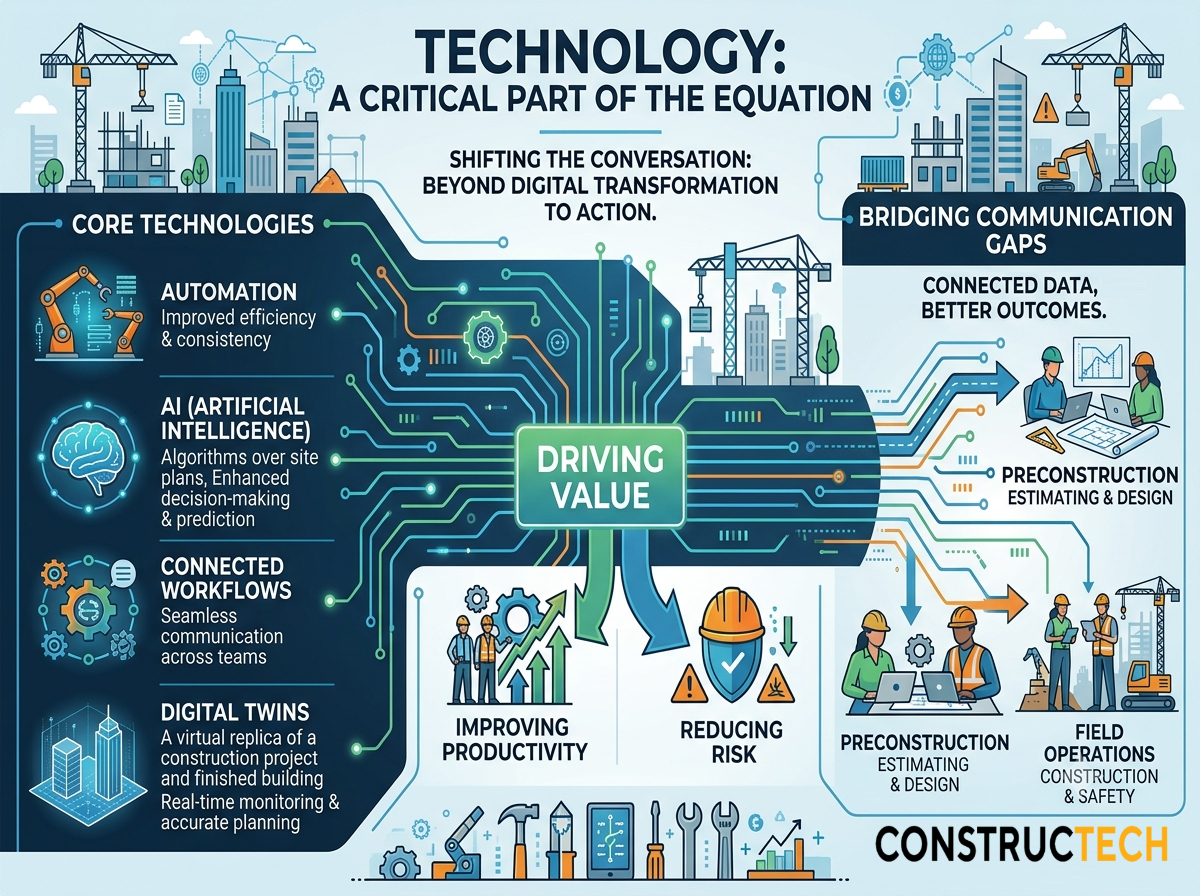
Technology is becoming a critical part of that equation. For years, the construction industry has discussed digital transformation, but today that conversation is shifting. Automation, AI (artificial intelligence), connected workflows, and digital twins are helping construction teams improve productivity while reducing risk. More importantly, these technologies are helping bridge communication gaps between preconstruction and field operations.
Let’s consider the example of BIM (building information modeling), which continues to play an important role in construction’s evolution. Coordinated models can reduce clashes, improve scheduling, and give every stakeholder greater visibility throughout a project’s lifecycle. As projects become more complex, contractors are looking for ways to make BIM more accessible and easier to manage across multiple trades.
One example is Beam AI’s recently introduced BIM CoPilot, which extends the company’s AI capabilities beyond preconstruction and into the build phase, giving contractors another option for connecting estimating, planning, and more.
However, technology alone is not the solution. Success will depend on people, processes, and partnerships working together. JLL’s report suggests labor could continue to be a challenge, with 61% of U.S. metro markets currently supply constrained, with pipeline growth running materially ahead of labor force growth. That share rises to 72% by 2027.
The markets where construction pipelines are expanding fastest are not where available labor is concentrated, according to JLL. Trades are locally credentialed, regionally organized, and project-bound; they don’t arbitrage this mismatch the way other markets might. The labor environment that owners bidding 2027 and 2028 projects will face is already visible in today’s supply-constrained markets.
The reality is the construction companies that invest in people, process, and technology today will be better positioned to navigate tomorrow’s challenges.
Want to tweet about this article? Use hashtags #construction #IoT #sustainability #AI #5G #cloud #edge #futureofwork #infrastructure