

For years, construction companies have been told that technology will transform the industry. We have seen it with BIM (building information modeling), drones, reality capture, connected equipment, digital twins, cloud-based project management, and AI (artificial intelligence). Now, we are moving from technology that helps workers do their jobs to technology that can increasingly do parts of the work itself.
That is where the idea of the frontier firm comes in, a concept I have written about in the manufacturing space. These organizations embed technology deeply into operations, use realtime data to make decisions, and continuously redesign how work gets done. Simply, a frontier firm has a hybrid team of humans and agents, and they can scale rapidly and operate with agility.
For the construction industry, that raises a key question: What will we call the people who manage this new digital workforce?
The Frontier Contractor
Imagine a project manager who no longer spends the first part of the morning collecting updates, checking schedules, searching emails, compiling reports, and determining which issues require attention. Instead, AI agents continuously monitor project information. One watches schedule performance. Another tracks RFIs (requests for information) and submittals. Another analyzes field progress. Another monitors procurement. Another prepares project reports.
Now, the human—the project manager—becomes responsible for managing all these AI agents. The humans increasingly become responsible for setting priorities, making decisions, managing relationships, handling exceptions, and taking accountability for the outcome. Meanwhile, the machines handle the information processing. That is the fundamental shift behind the frontier firm.
What Happens to Construction Titles?
This naturally leads to the question of whether we will see entirely new employee titles. We probably will—but perhaps not immediately. The first transformation may happen within existing jobs.
The superintendent could become an AI-enabled superintendent, managing both field crews and digital agents that monitor progress, documentation, safety, and coordination. The project manager could become a digital project manager, orchestrating humans and AI systems across the project lifecycle.
We could also see specialized positions such as an AI operations manager, construction intelligence manager, AI workflow architect, or agent operations manager. These roles would focus on making sure AI systems actually improve the business rather than simply adding another layer of technology.
This transformation also has to reach the jobsite. Imagine a foreman with an AI assistant that can track materials, document completed work, and provide access to the company’s accumulated knowledge. Imagine a skilled tradesperson being able to access the experience of dozens of veteran workers through an intelligent system.
The Construction Company That Learns
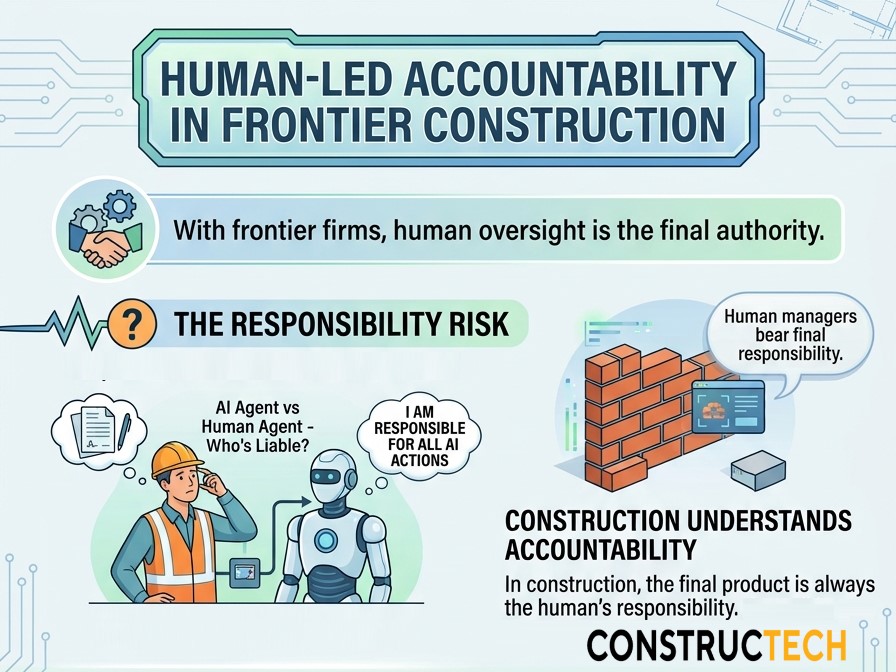
With frontier firms, there comes both risk and opportunity. Perhaps one of the biggest risks is with a mix of both human and AI agents, who is responsible when a mistake is made? Construction understands accountability better than most industries. If a wall is built in the wrong location, saying, “The AI made a mistake,” isn’t going to solve the problem.
That means the frontier construction company must remain a human-led company. AI can analyze more information, identify patterns, prepare recommendations, and execute routine tasks. But people still need to establish standards, exercise judgment, manage exceptions, and make decisions.
Still, there are also huge opportunities for a frontier contractor. Construction companies have accumulated enormous amounts of knowledge through decades of projects. Yet much of that knowledge remains scattered across documents, software systems, individual employees, and the memories of experienced workers.
A frontier contractor could begin connecting that knowledge. Every project could teach the organization something. The company then becomes a continuous learning organization.
The frontier firm will ultimately rebuild how work gets done. And the construction companies that understand that may be the ones building not only the projects of the future—but the workforce that will build them.
Want to tweet about this article? Use hashtags #construction #IoT #sustainability #AI #5G #cloud #edge #futureofwork #infrastructure