

In the warehouse and distribution center operational space, the required periodic task that is loathed and sometimes feared by operations people, and disruptive to daily order fulfillment operations, is the taking of a physical inventory of the merchandise stored and stocked within the four walls.
Merchandise stored and stocked in a warehouse or distribution center has a monetary value, and in the United States, owners of the merchandise must adhere to the accounting requirements of the FASB (Financial Accounting Standards Board). The FASB sets GAAP (generally accepted accounting standards) regarding how inventory is measured, valued, and reported based on the results of a physical inventory. Typically, the definitive “benchmark” physical inventory is done annually, but many companies have added quarterly inventories, and sometimes monthly depending upon the value of the merchandise.
Traditionally, “wall to wall” physical inventories had been done by the warehouse workers who were employed in the various inbound to outbound work processes. Regardless of what their “day to day” function was, all hands were required to walk the aisles and take inventories (“counting”) of every active and reserve stocking location within the four walls. The larger the warehouse, the longer the counting took, sometimes requiring more than a day to complete. This disrupted the fulfillment of orders, which impacted revenue generation.
The tools of the counting process evolved from paper-only to the use of RF (radio frequency) scanners, but in all cases, these were tools suited to human use.
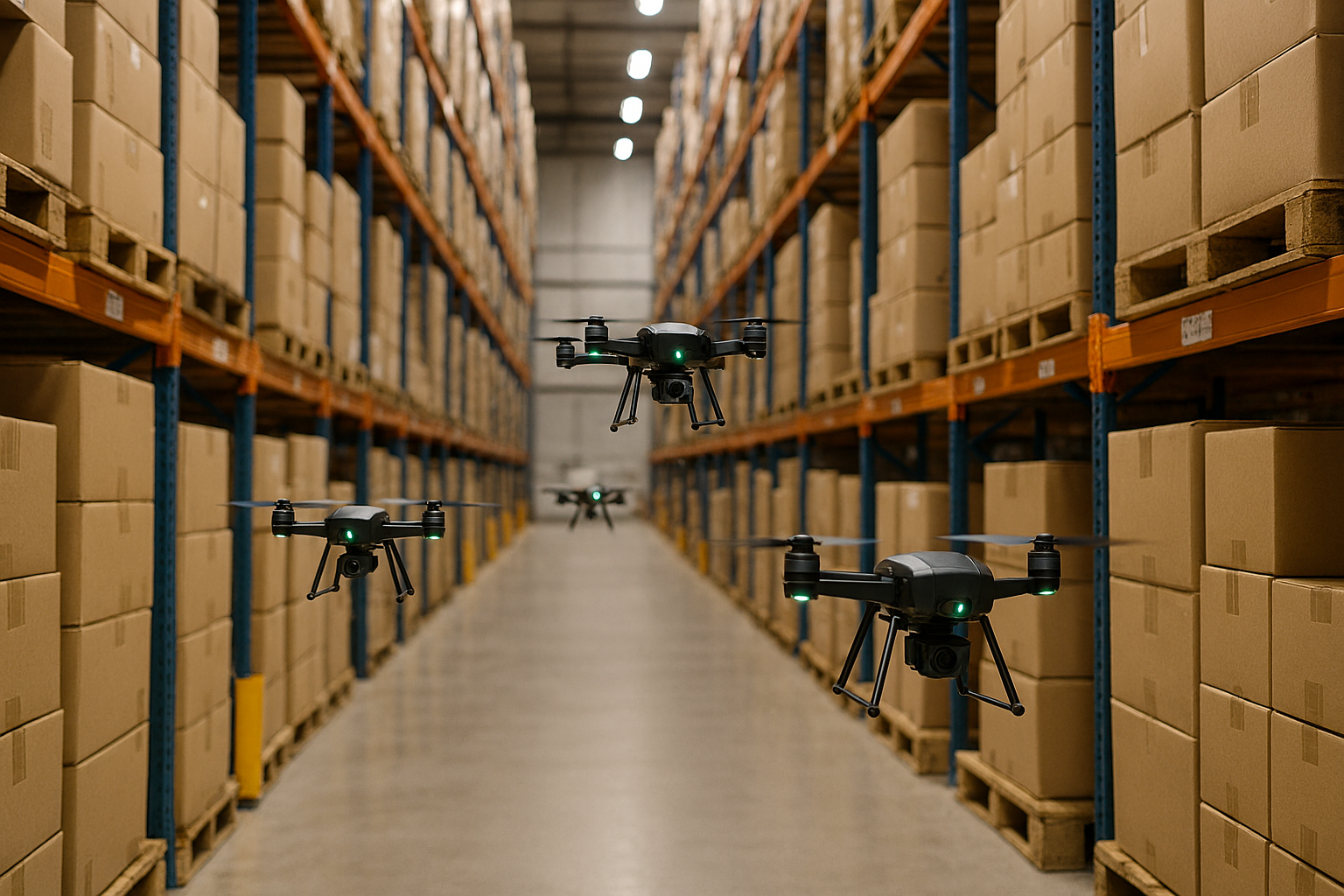
The latest technological evolution to impact the processes of the physical inventory is the substitution of drones for humans. Here’s an example:
Drones take physical inventory in warehouses by autonomously flying through aisles, using cameras and sensors to scan barcodes, QR codes, or RFID tags at high speed. They compare scanned data against the WMS (warehouse management system) to detect discrepancies, misplaced items, or low stock in realtime. This process increases inventory frequency and accuracy, improves worker safety (by eliminating the worker), and eliminates the need for manual, high-level, or time-consuming counting.
In short, using a drone instead of a human worker is a cheaper way of counting inventory, with the key contributing factors that drones can reduce counting time from many days (with humans) to a day or two (depending upon the size of the warehouse), and have a higher accuracy rate which reduces the need for “recounts” based on “book to physical” discrepancies (what you think you have versus what you actually have in a location).
What are the contributing factors to the higher accuracy and efficiency of drones?
- Autonomous Navigation: Drones use pre-programmed maps and sensors to navigate aisles, avoiding obstacles and navigating large facilities without human input.
- Data Collection: Equipped with cameras and scanners, they capture inventory data on pallets, boxes, and individual items, often reading 2D codes, RFID (radio-frequency identification), and text with far less errors than humans. Additionally, as required by GAAP to prevent fraud, the need for a human observer of the human counter (a two-person cost impact) is eliminated.
- WMS Integration: Scanned data is directly uploaded to the cloud and integrated into the WMS, providing instant updates and generating discrepancy reports.
- Night Operations: Many drones operate during overnight shifts when human activity is minimal, allowing for safe, around-the-clock auditing without disrupting operations.
On balance, the rise of the use of drones in the management of physical inventory offsets the increasing problem of the scarcity of human labor for warehouse and distribution center work processes. And while not a one-for-one substitution, the rise of jobs that will manage and maintain the drones used in warehouses and distribution centers represents an interesting evolution in the future of work as we know it.

About the Author
Tim Lindner develops multimodal technology solutions (voice / augmented reality / RF scanning) that focus on meeting or exceeding logistics and supply chain customers’ productivity improvement objectives. He can be reached at linkedin.com/in/timlindner.