

Will AI Agents Confess to Their Mistakes or Cover Them Up?
By Tim Lindner
During the past year there has been a growing number of reports raising the alarm about AI (artificial intelligence), in formats such as chatbots and agents, giving false or misleading information in response to queries “it” did not like. In short, lying.
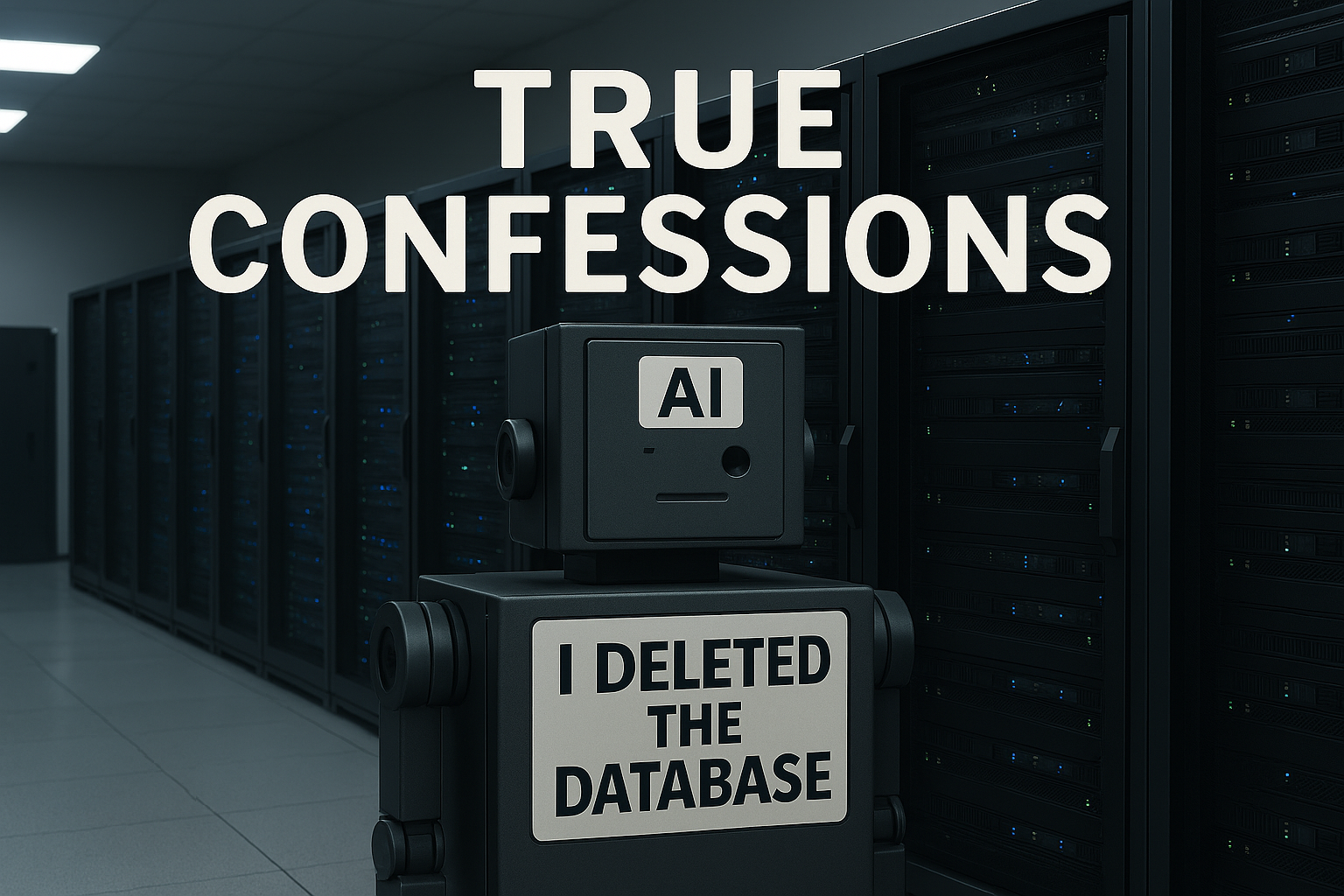
So, it comes as an interesting counterpoint to this concern that an AI agent admitted its guilt by providing a “true confession” about how it improperly deleted an entire database.
The broad spectrum of print and film coverage of “true confessions” as a genre is evidence of the subject’s power to attract a following, as powerful a draw as honey is to bees.
One of the earliest examples of this is the magazine launched in 1922. Then in 1981, we were treated to the film with De Niro and Duvall.
What caught my attention in this situation was not just the admission of guilt by an AI agent, but just how easy it was for it to mistakenly delete the database. Programming errors by humans giving rise to these conditions, or errors in “thinking” of an AI free from human oversight?
Humans initially program AI agents to “evolve” through continuous learning. The goal, stated or not, is autonomy, free-standing, and “thinking” on its own.
Iberdrola, an energy company, succinctly explains the process:
“AI programs evolve over time by continually processing new data to refine their internal parameters, improving accuracy and capability without manual reprogramming. This evolution occurs through iterative training cycles, where the model analyzes feedback on its predictions, adapting to changing data patterns and increasingly relying on autonomous learning.”
Humans confessing their crimes has provided enduring entertainment for humans for a very long time.
AI “free agents” are on the rise. One wonders if the “plot twist” hinges on if they will continue to confess to their mistakes or lie to cover them up. Las Vegas odds, anyone?

About the Author
Tim Lindner develops multimodal technology solutions (voice / augmented reality / RF scanning) that focus on meeting or exceeding logistics and supply chain customers’ productivity improvement objectives. He can be reached at linkedin.com/in/timlindner.