

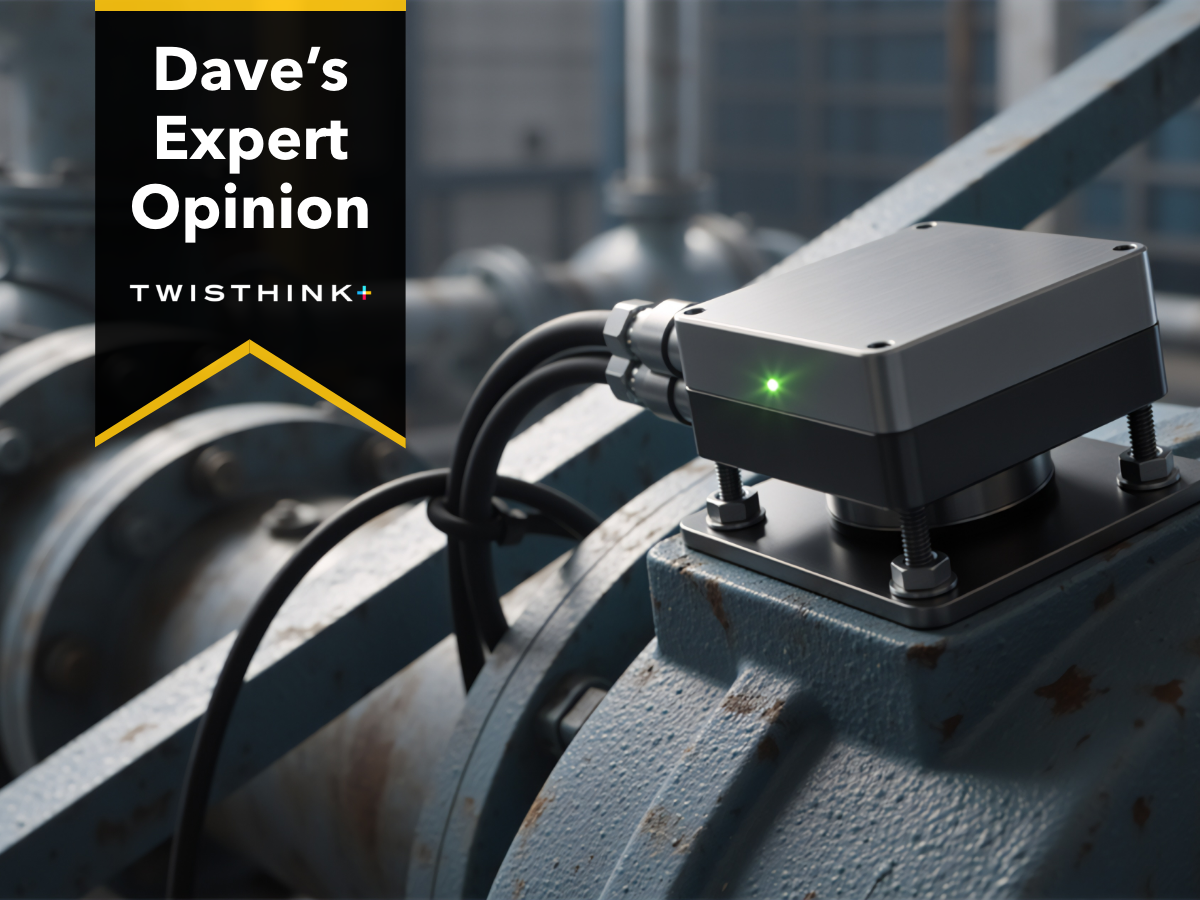
In industrial and rugged environments, batteries have long been treated as a necessary part of connected technology. But for many organizations, batteries introduce a hidden cost that extends far beyond the device itself: maintenance, downtime, and user frustration.
When companies invest in connected sensors, wearables, or monitoring systems, the goal is usually to improve productivity, visibility, or reliability. Yet too often, the technology creates a new burden. Someone has to charge the battery. Someone has to replace it. Someone has to remember when it’s running low.
That burden becomes a barrier to adoption and scale.
We’ve seen firsthand how this plays out in the field. One customer deployed sensors to improve operations, only to hear from technicians that the solution actually made their jobs harder because it added another maintenance task to their daily routine. The technology worked, but the experience didn’t.
That’s why one of the most important questions we ask when designing connected products is not, “How do we power this device?” It’s, “How do we make the user experience better?”
The answer often requires looking beyond the device itself and rethinking the entire system.
Consider our work with a warehouse equipment manufacturer that developed a wearable remote-control system, which allows warehouse operators to control lift trucks while walking alongside them. The original remote required a 12-hour charging cycle, a process operators dreaded because it interrupted workflows and reduced productivity.
Rather than simply improving battery capacity, the team challenged the assumption that charging had to happen overnight.
The result was a completely different approach: a rapid-charging remote paired with automated system upgrades. Operators could place the remote on the truck for just five seconds and receive enough charge for four hours of operation. Combined with a redesigned BLE (Bluetooth Low Energy) solution for improved range and reliability, the solution transformed the user experience and helped drive a 25% productivity increase.
The breakthrough didn’t come from a better battery. It came from thinking differently about how the entire system worked.
The same principle applies in some of the world’s harshest environments.
Working with charity: water, we helped develop a sensor system that predicts when hand pumps are likely to fail, helping keep clean water flowing to communities that depend on them. The device captures more than 13 million water samples per day through a custom-designed sensing system while operating in remote, rugged conditions.
In this case, eliminating batteries entirely wasn’t practical. Instead, the challenge became maximizing longevity and minimizing maintenance. By carefully designing the electronics and power architecture, the sensor can operate for up to 10 years without requiring battery replacement. It can also be retrofitted to existing pumps and withstand demanding environmental conditions, all while representing just 2% of the total pump cost.
The lesson is that there is no universal answer to power management. Sometimes the right solution is battery-free technology. Sometimes it’s energy harvesting. Sometimes it’s ultra-low-power design that makes batteries effectively disappear from the maintenance equation.
What matters is focusing on the user experience rather than the component itself.
Too many product teams start with the battery and accept its limitations as a fixed constraint. The most successful teams challenge those assumptions. They ask whether charging can happen differently, whether power can be harvested, whether energy consumption can be reduced, or whether the workflow itself can be redesigned.
There are always tradeoffs. But the best innovations often emerge when you stop optimizing the battery and start optimizing the system.
Because at the end of the day, customers shouldn’t have to think about how to power their sensors. They should simply trust that the technology will work when they need it.
If your connected solution relies on batteries and you’re looking to reduce maintenance, improve adoption, or create a better user experience, let’s talk. Together, we can explore new ways to rethink power and potentially create a maintenance-free solution.

About the Author
As Twisthink’s CEO, Dave brings a unique blend of technical expertise and strategic leadership to advance what’s possible through connected product development. His roots in RF communications, embedded systems, and signal processing, combined with experience across engineering, product strategy, business development, and operations, allow him to bridge business needs with engineering possibilities to create impactful solutions for clients. Dave can be reached at: davem@twisthink.com